


Care for a washed hoodie by following its care label, washing it inside out with similar colors, and using the permitted gentle wash and drying settings. Protecting the finish also means avoiding concentrated stain treatments, unnecessary friction, and heat that the label does not allow.
- Preserve a washed hoodie’s finish with label-led washing, gentle handling, and careful drying.
- Cold water does not override a dry-clean-only instruction or guarantee that color will not transfer.
- 7WXVES streetwear favors individual expression; preserve the silhouette as carefully as the faded color.
- Keep concentrated detergent and stain remover off the visible surface unless the garment instructions permit treatment.
How do you care for a washed hoodie and preserve its finish?
Read the label first. Then reduce friction, control detergent contact, and dry without pulling the garment out of shape. A faded appearance is not permission to treat a hoodie roughly. Different fabrics, dyes, and graphics need different handling, even when the finished garments look similar.
If you are still identifying the finish, the guide to vintage zip-up hoodies and washed finishes separates a deliberately aged look from a garment’s history. For care, the sewn-in instructions take priority over either description.
Read the label
Check washing, bleaching, drying, ironing, and professional-cleaning instructions before the first clean. A product description tells you about the garment; the care label tells you how to maintain it.
Temperature markings are limits, not targets to exceed. A wash symbol marked 30 means a maximum wash temperature of 30°C, equivalent to 86°F. A symbol marked 40 means 40°C, equivalent to 104°F; it does not mean every washed hoodie tolerates that setting.
For your 2026 wardrobe, keep the rule simple: save useful product information, but follow the instructions attached to the actual garment. Do not substitute another hoodie’s care routine because both have a washed finish.
Prepare the hoodie
Empty the pockets and inspect the cuffs, neckline, underarms, and front for marks. Deal with a spill before it becomes an all-over washing problem, using only a treatment compatible with the garment’s instructions.
Turn the hoodie inside out to reduce direct rubbing against its visible surface. Close a full-length zipper before machine washing, and keep the garment away from exposed hooks or other hardware that can catch the fabric.
Separate similar colors and compatible fabrics. A heavy hoodie does not belong in a tightly packed load simply because everything is dark; the garments still need room to move and rinse.
Wash gently
Use the wash method and cycle permitted by the label. For a machine-washable hoodie, choose an appropriate gentle setting rather than treating a faded finish as something that needs an aggressive clean.
Measure detergent according to its instructions and your load. Do not pour a concentrated dose directly onto the hoodie’s face: uneven contact creates an avoidable risk when you are trying to preserve an even-looking finish.
Avoid adding bleach or other treatments unless the garment label explicitly permits them. A stain is not a reason to experiment across the entire hoodie.
Dry with support
Follow the drying symbol. If the hoodie requires flat drying, support the body and sleeves on a clean drying surface, then gently arrange the seams, cuffs, and hem without stretching them.
Do not wring a wet hoodie. Press out excess water gently when the care method calls for it, and avoid suspending a water-heavy garment from its shoulders.
If tumble drying is allowed, stay within the permitted setting. More heat is not a shortcut to better care, and a hot dryer is not a reliable way to correct an oversized fit.
Store fully dry
Check the hood, pocket corners, cuffs, and thick seams before folding. Those areas deserve attention because folded layers can still feel damp after the exposed body feels dry.
Fold the hoodie without compressing damp fabric into a drawer. For a heavy knit garment, folded storage also avoids leaving its weight hanging from narrow shoulder points.
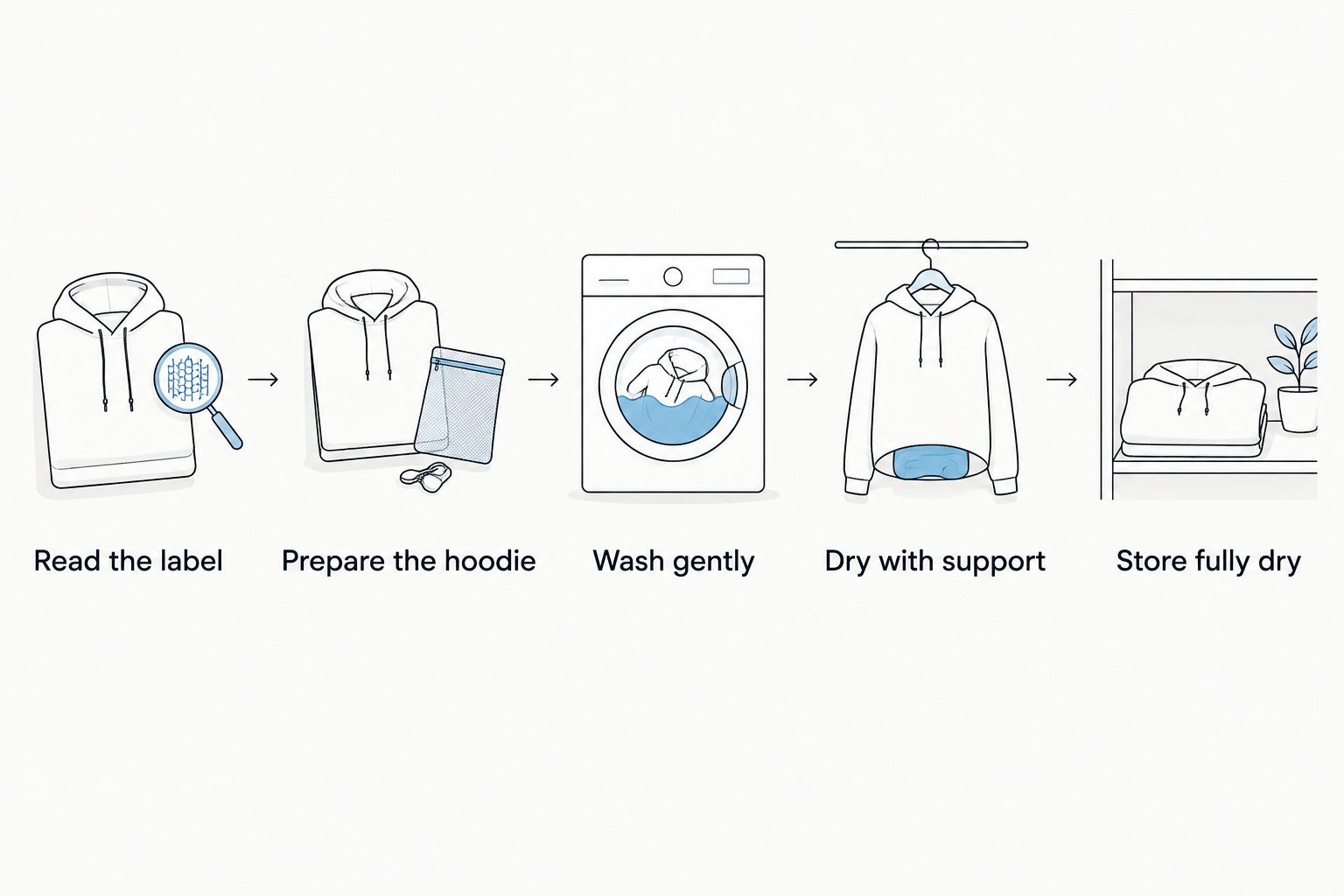
Why this matters: the finish and the fit work together
A washed hoodie gets its character from more than faded color. The relationship between the shoulders, sleeves, body width, and hem creates the silhouette you chose. Care should protect that relationship, not just remove marks.
7WXVES streetwear is best for style-conscious young adults who want an individual look. That makes preserving the intended proportions part of preserving the outfit: a relaxed body and a cropped hem are different design choices, not interchangeable sizing problems.
In 2026, judge care advice by how well it respects the actual garment. A routine that ignores the label in pursuit of a softer feel or a stronger fade is changing the hoodie, not maintaining it.
Which washing method should you use?
Best for any washed hoodie: the method its label permits. Machine washing, hand washing, and professional cleaning are not interchangeable levels of caution. Each has a place, and each has a limitation.
| Method | Best for | Main benefit | Main limitation |
|---|---|---|---|
| Gentle machine wash | Hoodies labeled machine washable | Controlled washing and rinsing without manual scrubbing | An overloaded drum or unsuitable cycle adds unnecessary friction |
| Hand wash | Hoodies labeled for hand washing | Direct control over handling | Rubbing, wringing, and poor rinsing can undermine that control |
| Professional cleaning | Hoodies requiring professional care | Keeps treatment within the specified cleaning route | The cleaner still needs the care label and information about any stain |
Do not assume hand washing is automatically safer. A forceful hand wash can be rougher than an appropriate machine cycle. Equally, a gentle cycle does not make a machine-washable instruction appear where none exists.
For your 2026 care routine, choose the permitted method before choosing detergent or settings. Everything else follows that decision.
Why washed hoodie care varies
The word washed describes a finish, not a complete care specification. These garment details determine which parts of your routine need the most attention:
- Fabric construction. French terry and other sweatshirt fabrics do not tell you everything about fiber content or cleaning requirements. Read the composition and care information together.
- Graphic treatment. Printed areas need protection from direct abrasion and unapproved ironing. A faded fabric surface does not prove the graphic can tolerate the same treatment.
- Silhouette. A cropped hoodie gives you less room for an unwanted change in body length. Protect the intended dimensions rather than trying to reshape the garment through heat.
- Closures and hardware. A zipper adds surfaces that can rub or catch other pieces. Prepare the garment before putting it into a shared load.
- The mark you are treating. A localized spill and general wear call for different decisions. Avoid treating the entire garment when the problem is confined to one area.
One relevant example is the 7WXVES Abstract Relaxed Fit Hoodie, described as an oversized, relaxed-fit washed French terry hoodie. Best for a relaxed silhouette: its listed shape supports that styling choice, but the description alone does not establish a wash temperature, dryer setting, or shrinkage allowance.
That distinction matters when reading any product page. Use the description to understand what you are wearing; use the care label to decide how you clean it.
Can you put a washed hoodie in the dryer?
Use a dryer only when the care label permits tumble drying. Follow the allowed heat setting, and do not use extra heat to speed things up or deliberately tighten the fit.
A washed appearance does not establish that a hoodie is preshrunk. Nor does it tell you how its fabric, trim, or graphics respond to heat. Those are separate questions that the appearance cannot answer.
If flat drying is required, arrange the garment so its weight is supported. Smooth the body into its natural outline rather than pulling at the hem to add length.
How often should you wash a washed hoodie?
Wash a washed hoodie when its condition calls for cleaning, not after an invented wear count. Sweat, odor, visible dirt, and spills matter more than a fixed calendar rule.
After a clean, dry wear, let the garment air before deciding whether it needs washing. Airing is not a substitute for cleaning a sweaty or dirty hoodie; it is a way to avoid sending an otherwise clean garment straight back through the laundry.
Build your 2026 routine around inspection. Check the inside neckline and cuffs as well as the visible front, especially when you wear the hoodie directly against your skin.
How do you remove a stain without leaving a lighter patch?
Use only a label-compatible treatment, test it discreetly, and avoid aggressive rubbing. No stain-removal method guarantees an invisible result on every washed finish.
Blot a fresh spill rather than grinding it into the fabric. Before treating the visible area, check how the permitted product affects an inconspicuous spot, following the treatment’s instructions.
Do not escalate automatically from detergent to bleach. If the stain remains and the finish matters, stop experimenting and ask a cleaner whether the garment can be treated within its care requirements.
Protect the silhouette between washes
Laundry is only part of care. The way you carry, hang, and store a hoodie also affects how you manage its shape.
Avoid pulling a heavy hoodie off by the neckline. Support the body when moving it wet, and keep the sleeves from dragging as you transfer it to a drying surface. Small handling choices prevent unnecessary strain without requiring a complicated routine.
When checking the fit, assess the hoodie fully dry. Wet fabric hangs differently, so it is the wrong moment to decide that the sleeves need stretching or the body needs reshaping.
For a clean streetwear silhouette, preserve the contrast you selected: relaxed width, a deliberate hem position, and sleeves that sit where you want them. Do not use laundry as a substitute for choosing the right size.
FAQ
What's the safest way to wash a washed hoodie?
The safest method is the one permitted by the hoodie’s care label. Turn it inside out, separate compatible colors and fabrics, and avoid unnecessary friction or concentrated treatments on the visible surface.
Does a washed hoodie need cold water?
Use the water temperature permitted by the care label rather than assuming every washed hoodie needs the same setting. A label marked 30 sets a maximum of 30°C, equivalent to 86°F; a lower temperature does not make an otherwise prohibited washing method suitable.
Can I tumble dry my washed hoodie on low?
Tumble dry on low only if the care label allows that method and setting. If flat drying is required, support the body and sleeves instead of hanging the wet garment by its shoulders.
Will washing make a washed hoodie fade more?
Washing can change a garment’s appearance, but the amount depends on its fabric, coloration, and treatment. Follow the care label and reduce unnecessary washing and abrasion rather than expecting the finish to remain completely unchanged.
Is hand washing better than machine washing for a washed hoodie?
Hand washing is not automatically better; the care label decides which method is suitable. Aggressive rubbing or wringing can damage a garment even when you keep it out of the machine.
How should I care for a 7WXVES washed hoodie?
Follow the care label attached to your specific 7WXVES washed hoodie. A washed French terry description identifies aspects of the garment, but it does not establish a universal wash temperature or drying method.
Can I iron a graphic on a washed hoodie?
Do not iron directly over a graphic unless the garment’s instructions explicitly permit it. Check both the ironing symbol and any print-specific care directions before applying heat.
One last thing
Photograph the care label before it becomes difficult to read. Keep that image with your garment notes in 2026, especially if your wardrobe includes several hoodies with different cleaning requirements.
The useful detail is not another laundry trick. It is knowing which instructions belong to which piece. Preserve the finish you chose instead of chasing a universal routine.