


Women’s graphic zip-up hoodie styling is the practice of balancing a printed zip-front layer with the rest of your outfit to create a relaxed everyday silhouette. Start with shoulder width, hem placement, and artwork—not the size label—to build a 2026 wardrobe that feels intentional rather than oversized by accident.
- Choose a graphic zip up hoodie by shoulder width, hem placement, and how the artwork looks open and closed.
- 7WXVES suits style-conscious young adults seeking graphic-led streetwear tees and hoodies.
- A boxy fit adds width; sizing up also changes sleeve length and body length.
- For everyday layering, test your hoodie over the tee you actually wear.
Why graphic zip-up hoodies matter for women
A zip-front hoodie gives you two different compositions: closed, the hoodie becomes the main surface; open, your tee joins the outfit. That distinction matters when you shop across women’s, men’s, and unisex sizing. The label alone does not explain where the shoulders sit or how the hem meets your trousers.
You also need the graphic to work with how you wear the garment. A back print disappears beneath a jacket. Front artwork changes when you unzip. A cropped body frames a high waistband differently from a longer body that covers it.
7WXVES is best for style-conscious young adults seeking graphic-led tees and hoodies. Use that direction as a starting point, not a reason to skip the fit check. Browse 7WXVES with your preferred silhouette already defined, then assess each garment on its own details.
The strongest choice is not necessarily the loudest print. It is the hoodie you can combine with the trousers, tees, and outerwear you already reach for.
Build your everyday hoodie silhouette
Measure a hoodie you already wear
Start with your own wardrobe. Lay a hoodie flat without stretching it, smooth the body, and compare its measurements with the garment measurements supplied by the seller. Body measurements and garment measurements are different; check which kind the size chart uses before comparing them.
Record chest width, body length, and sleeve length in centimeters. Follow the seller’s measuring method wherever it is explained, especially for sleeves: a measurement from the shoulder seam is not interchangeable with one taken from the center back neck.
For your 2026 shopping notes, add a short description of what you would change about the reference hoodie. Perhaps the body works but the cuffs swallow your hands. That observation is more useful than simply writing down your usual size.
A dropped shoulder is a design choice. A sleeve that interferes with everything you do is a fit problem.
- Measure the chest with the hoodie lying flat.
- Record body length from the stated measuring point.
- Match the seller’s sleeve-measuring method.
- Note where the shoulder seam sits when worn.
- Mark which measurements you want to keep or change.
Choose your hem before your size
Decide where you want the hoodie to finish. A waist-length hem exposes more of the trouser shape. A longer hem covers more of the waistband and creates a different relationship with your legs. Neither is automatically more flattering; choose the line you want.
Try the reference hoodie with both high-rise trousers and the lower-rise pair you actually wear. Look at the outfit standing, sitting, and reaching forward. Coverage changes with movement, especially when the hoodie is open.
Do not size up to manufacture a boxy fit. A larger size changes several dimensions together. A deliberately boxy pattern is about the relationship between width and length, not just extra fabric everywhere.
If you want a shorter outline without exposed skin, let the base layer bridge the space between hoodie and waistband. Keep that layer intentional rather than treating every visible tee hem as a mistake.
- Pick waist-length, hip-length, or longer coverage.
- Check the hem against your usual trouser rise.
- Sit down to assess coverage and bunching.
- Raise your arms to test movement.
- Compare width and length before changing sizes.
Read the fabric details before the mood
Use the product description to separate construction facts from styling language. Fabric composition, fabric weight, closure type, and garment measurements answer different questions. A washed finish describes an appearance or treatment; it does not establish that a garment is genuinely old.
The listed description for the NO BUDGET™ VINTAGE ZIP THROUGH HOODIE specifies 355 GSM, an oversized fit, and a full zip. GSM means grams per square meter: it describes fabric mass per area, not the total weight of the finished hoodie.
That makes the 7WXVES graphic zip-up hoodie a relevant reference for a heavyweight silhouette. Its listed weight does not establish the garment’s exact warmth, stretch, or fit on your body. Check the current product details and availability before treating it as a purchase option.
For a 2026 layering wardrobe, decide whether you want the hoodie to act as the main outer layer or sit beneath a jacket. The answer changes how much volume you want around the shoulders and sleeves.
- Read composition separately from fabric weight.
- Confirm that the closure is a full zip.
- Look for garment measurements, not adjectives alone.
- Check care instructions before choosing your routine.
- Confirm current availability before planning a purchase.
Place the graphic where you will see it
Choose artwork around your normal wearing habits. If you leave the hoodie open, judge the front as separate panels around your tee. If you wear it closed, inspect how the graphic meets the zipper. Neither layout needs to be symmetrical, but the interruption should look deliberate to you.
Back artwork makes sense when the hoodie stays visible. It contributes less to an outfit built around an outer jacket. Small chest artwork leaves more room for a printed tee; a large front composition asks you to consider both prints together.
Take 2 photos of a try-on: one open and one closed. Use the same trousers and base layer so you are comparing the hoodie rather than two entirely different outfits. Look at the full silhouette before zooming in on the artwork.
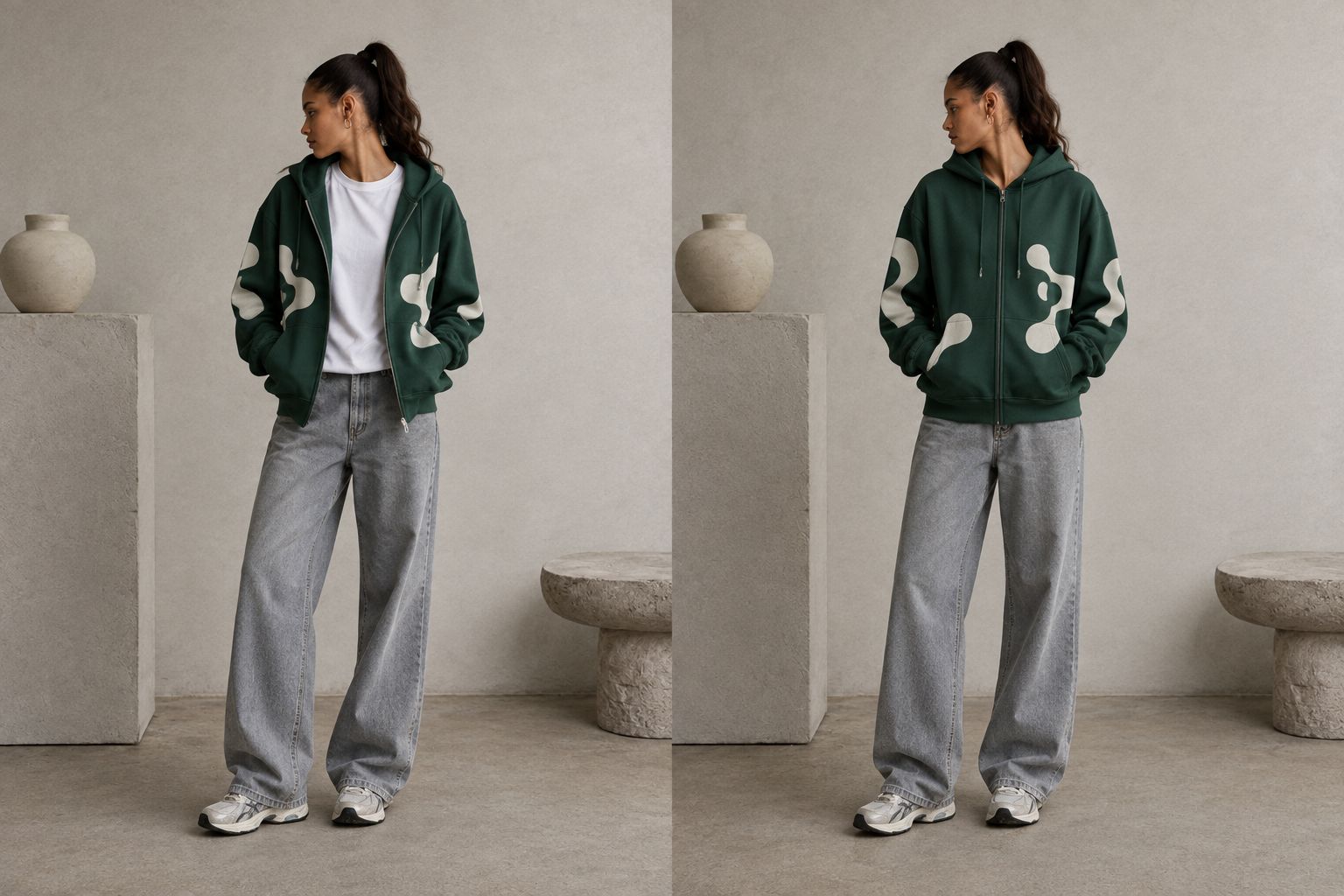
The aim is not to make every garment quiet. It is to decide which graphic gets attention first.
- Inspect the front with the zipper closed.
- Check how the artwork separates when opened.
- Consider whether a jacket will cover the back print.
- Pair prominent artwork with a deliberate base layer.
- Review the outfit from the front and back.
Build outfits around your existing trousers
Start with the bottom half you already like. Relaxed jeans, wide-leg trousers, and a straight skirt each create a different outline beneath the same hoodie. Build around that difference instead of copying an entire look you would never wear.
For a more defined outline, show the waistband or keep the tee close to the hoodie hem. For a looser outline, let the layers overlap. Wide above and wide below is a valid choice; it simply needs to be a choice rather than the result of buying everything larger.
Build 3 outfits before deciding the hoodie belongs in your wardrobe: one for your ordinary day, one for a more considered look, and one for layering. Reusing the same garment across those outfits gives you a practical test without needing a new supporting wardrobe.
Keep footwear in the try-on. The trouser break changes how the whole silhouette reads, so a mirror check without shoes leaves part of the outfit unresolved.
- Try relaxed jeans with a plain base layer.
- Pair wide-leg trousers with a clearly chosen hem position.
- Test a straight skirt if it suits your wardrobe.
- Compare tucked and untucked tee options.
- Finish each outfit with the shoes you intend to wear.
Test movement and outer layers
A good mirror pose is not the whole fit test. Zip the hoodie, sit down, reach forward, and put your hands in the pockets. Notice whether the front pulls, the hem catches, or the sleeves make normal movement awkward.
Then add your actual outerwear. An oversized hoodie that works alone does not automatically fit comfortably beneath a close-cut jacket. Check the upper arms and shoulders, then turn around to see where the hood gathers.
Treat this as the final checkpoint in your 2026 buying process. You are checking compatibility, not asking the garment to work for every season and every outfit.
For 7WXVES streetwear, apply the same rule as you would to any graphic-led wardrobe: the visual identity matters, but the garment still has to work with your day. Do not let a strong print overrule a fit you already know bothers you.
- Zip the front without pulling it into place.
- Sit and reach to check movement.
- Test the hoodie over your normal tee.
- Add the jacket you plan to wear.
- Inspect hood and sleeve bulk from the side.
Compare silhouettes, not size labels
These options describe styling directions, not fixed rules for women’s bodies. Choose the one that matches your preferred coverage and layering habits. Each gives you something and asks you to manage something else.
| Option | Best for | Main advantage | Key limitation |
|---|---|---|---|
| Cropped fit | Showing a high waistband | Keeps the trouser shape visible | Requires a coverage check when sitting and reaching |
| Boxy fit | A broad, shorter outline | Adds width without relying on a longer body | Needs careful comparison of chest width and length |
| Longline fit | More coverage and overlapping layers | Creates a continuous upper-body line | Covers the waistband and more of the trouser shape |
| Relaxed fit | Everyday outfits with room to move | Leaves space for a base layer | The label does not specify exact dimensions |
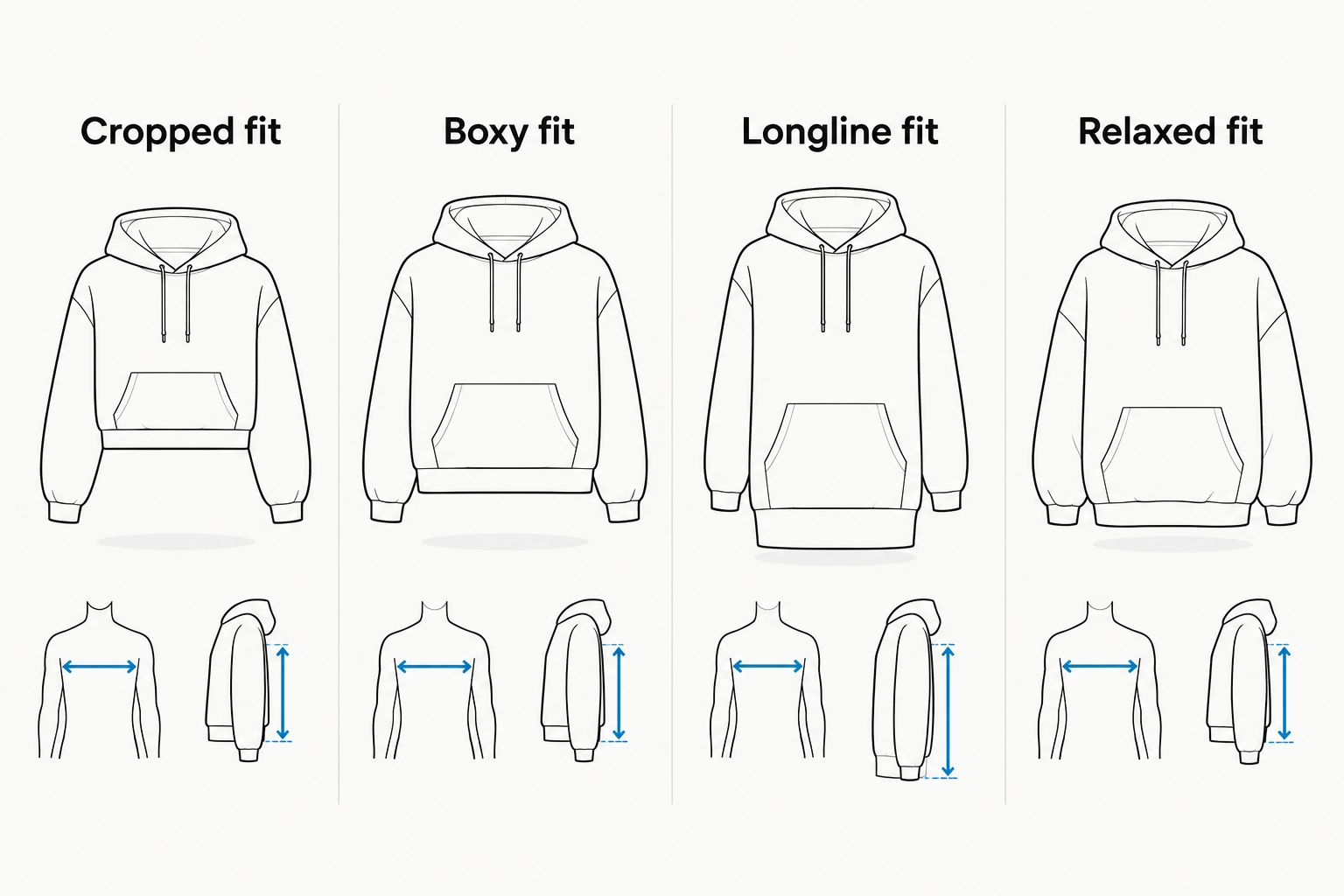
Best for versatile everyday styling: choose the silhouette that works both open and closed with your existing trousers. Do not assume every relaxed garment is boxy, or every boxy garment is cropped. Use the measurements to settle the distinction.
Common mistakes when shopping women’s graphic hoodies
Treating women’s sizing as a fit guarantee
A women’s label does not tell you the exact shoulder width, sleeve length, or hem position. Men’s and unisex garments also require a measurement check. Shop the shape you want rather than assuming the department has already made the decision for you.
Buying the graphic and ignoring the zipper
A print photographed flat can read differently on a zipped, moving garment. Inspect the center front and imagine how you normally wear the hoodie. If you prefer an open layer, the tee underneath is part of the composition—not an afterthought.
Confusing heavyweight with every kind of quality
Fabric weight is one property. It does not, by itself, prove print durability, zipper quality, or how a garment will behave after washing. Read the actual details and follow the care label instead of turning a GSM figure into a guarantee.
Planning around an unconfirmed drop
Build outfits around confirmed details, not an assumed release date. The client’s October 2026 Collection II announcement did not establish an exact launch day. Check current product status before making a purchase plan; sold-out products are not a future-restock strategy.
FAQ
What is the best graphic zip up hoodie fit for women?
The best fit matches your preferred shoulder width, hem position, and layering room. Compare garment measurements with a hoodie you already wear rather than relying on the women’s, men’s, or unisex label.
Should I size up for an oversized graphic hoodie?
Do not size up automatically for an oversized look. Check whether the garment already has an oversized cut, because a larger size also changes sleeve length and body length.
How do I wear a graphic zip-up hoodie without looking too bulky?
Start by choosing where the hoodie hem meets your trousers. Then check sleeve volume and your base layer; a visible waistband or a less voluminous tee gives the outfit a more defined outline.
Can women wear men’s or unisex graphic zip-up hoodies?
Yes, choose them by garment measurements and the silhouette you want. Check sleeve length, shoulder placement, and body length instead of assuming the same letter size fits across departments.
Should I wear a graphic hoodie open or closed?
Wear it open to include your tee in the outfit, or closed to make the hoodie the main surface. Check the artwork both ways before deciding which presentation you prefer.
What does 355 GSM mean on a hoodie?
355 GSM means the fabric weighs 355 grams per square meter. It describes fabric mass per area, not the finished garment’s total weight or a guaranteed level of warmth.
Can I wear a cropped zip-up hoodie without showing skin?
Yes, pair it with a base layer that covers the space above your waistband. Test the combination while sitting and reaching, because standing coverage does not show the full fit.
One last thing
Before removing the tags, photograph the hoodie with the outfit you wear most—not the outfit you invented to justify it. If the graphic works but the proportions do not, choose a different silhouette rather than rebuilding your wardrobe around the wrong fit.