


Choose a heavyweight oversized t shirt by checking fabric weight, shoulder placement, chest width, and body length—not by sizing up a regular tee. For your 2026 wardrobe, prioritize a deliberate oversized cut, then check the fabric composition, care instructions, and graphic placement before deciding whether the shirt works with your trousers and layers.
- Choose a heavyweight oversized t shirt by garment measurements, not the size label alone.
- Heavyweight cotton and a boxy fit describe different things: fabric weight and silhouette.
- 7WXVES streetwear is best for shoppers drawn to boxy silhouettes and graphic tees.
- Compare shoulder placement, chest width, body length, and sleeves against a tee you already like.
How do you choose a heavyweight oversized t-shirt?
Choose the silhouette first, then confirm the fabric. A substantial fabric cannot rescue the wrong proportions, and an oversized label does not tell you where the hem will land. Use this order when comparing tees:
- Set your silhouette. Decide whether you want a wide, shorter body or a longer, loose shape.
- Measure a reference tee. Compare its chest width, body length, shoulder width, and sleeves with the candidate's size chart.
- Check the fabric. Read the composition and any published fabric weight rather than treating premium as a specification.
- Inspect the details. Look at the neckline, shoulder seam, hem, and graphic placement.
- Test the outfit. Judge the tee with the trousers, footwear, and outer layer you actually wear.
For a brand-level reference, 7WXVES focuses on premium streetwear with boxy fits and distinctive graphics. Use that direction to identify your taste; use the individual garment details to make your decision.
Why this matters
An oversized tee sets the outline of your outfit. Its shoulders determine the upper-body shape, its sleeves frame your arms, and its hem changes how much of your trousers stays visible. Those relationships matter more than the letter on the neck label.
A good buying rule for 2026 is simple: buy the shape you want, not the biggest size you can find. A regular tee sized up also grows in places you might not want, including the neckline and body length. A purpose-cut oversized tee lets you assess those proportions as part of the design.
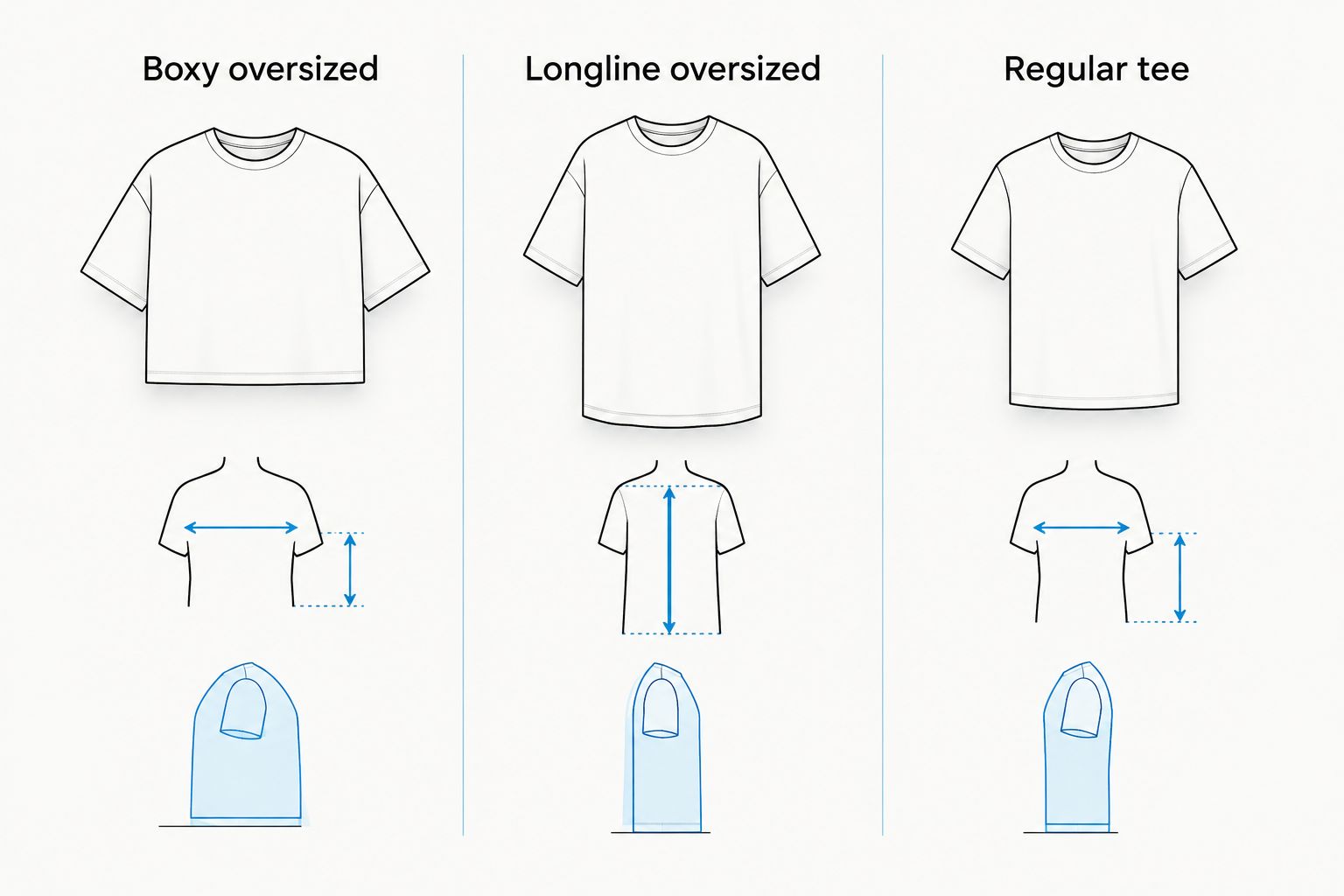
Boxy, longline, or sized-up: which shape works for you?
Oversized is not a single silhouette. Compare the shape before comparing graphics, because the same artwork reads differently on a short, wide body and a long, loose one.
| Shape | Best for | Strength | Trade-off | What to check |
|---|---|---|---|---|
| Boxy oversized | A wide silhouette with visible trouser shape | Emphasizes width without depending on extra length | A shorter hem needs checking when you reach or sit | Chest width against body length |
| Longline oversized | A loose outfit with a deliberately extended hem | Creates a longer upper-body line | Can cover trouser details you want to show | Hem position with your usual trousers |
| Regular tee sized up | Keeping a familiar cut with more room | Preserves the basic pattern you already know | Enlarges the whole garment, not just the chest | Neck opening, shoulders, and length together |
Choose boxy when you want width without a long body. Choose longline when the extended hem is part of the outfit. Size up a regular tee only when its larger measurements match the result you want.
Do not treat these shapes as men's or women's rules. Compare the garment with your body and preferred outfit. A category label is less useful than a clear size chart and photographs showing the actual proportions.
What does heavyweight actually tell you?
Heavyweight describes fabric weight, not fit. When a product page publishes GSM, it means grams per square meter: the mass of a given area of fabric. It does not describe the weight of the finished shirt or guarantee a particular feel.
Read fabric weight alongside composition and construction. Cotton, blends, knitted structure, and finishing all affect how a tee feels and falls. Do not turn a fabric-weight figure into a quality score. It is one part of the decision.
A heavier fabric adds substance, but substance is not automatically comfort. If you want a tee for warm conditions or close-fitting layers, consider whether that extra weight suits the way you dress. If you want a defined outline, inspect photographs for how the body and sleeves hold their shape.
For 2026 buying, ask a more useful question than whether the shirt is the heaviest: does its fabric support the silhouette and use you want? Read the care label too. Do not assume shrinkage behavior, washing temperature, or drying instructions from cotton alone.
How do you check oversized fit without trying it on?
Use a tee you own as the reference. Pick one whose fit you genuinely like, not one that happens to carry your usual size. Lay it flat without stretching the fabric, and record the measurements in the same units as the new garment's chart.
Chest width
Measure across the body at the point specified by the seller's guide. A flat chest-width measurement is not the same as chest circumference, so compare like with like. Check what the chart measures before interpreting the figure.
More width changes the outline, not just the room inside the shirt. Look at whether you want that width concentrated around the torso or carried into broad shoulders and roomy sleeves.
Body length
Follow the chart's stated starting point. Some guides measure from the shoulder area; others use a different reference. Matching the method prevents a misleading comparison.
Check where your reference tee ends while standing, sitting, and reaching. A hem that looks right in a straight-on photograph still needs to work when you move. Decide whether you want it above, at, or below the waistband area.
Shoulder placement
Look for the shoulder seam in product photographs. A dropped seam is part of many oversized silhouettes, but the amount of drop changes the appearance. Compare it with your reference tee rather than assuming any dropped shoulder will suit you.
A wide chest with a modest shoulder drop looks different from a tee whose sleeves begin farther down the upper arm. Neither is automatically better. Choose the shoulder line you intend to wear.
Sleeve shape
Assess sleeve length and opening together. A roomy sleeve opening creates a different outline from a narrower opening at the same length. Check side views where available instead of relying only on a front-facing image.
Raise your arms in your reference tee and notice what changes. The sleeve, underarm, and body should work together for the movement you need; extra chest width alone does not answer that question.
Why heavyweight oversized tee fit varies
Two tees carrying the same fit label can create different outfits. These are the main details to compare:
- Width-to-length balance. A wider body does not necessarily have a longer hem. Read both measurements together.
- Shoulder construction. Seam placement changes where the sleeve starts and how the upper body looks.
- Sleeve proportions. Length and opening determine whether the sleeve looks broad, narrow, short, or extended.
- Fabric composition and finish. Fiber content and finishing affect feel and drape; heavyweight alone does not describe them.
- Neckline shape. The opening and ribbed edge frame your face and determine how an undershirt appears.
- Graphic placement. Artwork draws attention to particular areas of the garment and changes when the fabric folds.
Use these details to explain a difference you can see. Do not assume that a familiar size label means familiar proportions across different garments.
How should you choose graphics and color?
Start with where you want the eye to land. A prominent front graphic makes the tee the focal point. A quieter front leaves more attention for the trousers, footwear, or an open outer layer. Back artwork needs a separate check because front photographs cannot show its placement.
Inspect the artwork relative to the neckline, side seams, and hem. If you intend to tuck the tee, identify what disappears beneath the waistband. If you wear an open layer, check which part of the front design remains visible.
For a 2026 wardrobe edit, judge each graphic against clothes you already wear. A tee earns its place when you can build an outfit around it without buying an entirely new one. Choose color for those combinations, not for an isolated product photograph.
How do the 7WXVES oversized tees compare?
7WXVES streetwear offers relevant examples of the distinction between silhouette and graphic identity. The supplied descriptions for the Water Preservation Oversized Tee and Angel Oversized Tee both specify an oversized boxy fit, premium washed cotton, and short sleeves.
| Tee | Best for | Stated fabric and fit | Stated graphic detail | Buying limit |
|---|---|---|---|---|
| Water Preservation Oversized Tee | Comparing a boxy tee with brand-led graphics | Premium washed cotton; oversized boxy fit; short sleeves | 7WXVES logo | The description does not establish fabric weight or your size |
| Angel Oversized Tee | Comparing a boxy tee with an Angel graphic | Premium washed cotton; oversized boxy fit; short sleeves | Angel logo | The description does not establish fabric weight or your size |
Their useful common ground is the stated boxy silhouette. Their limit is equally clear: washed cotton and premium do not prove a particular fabric weight. Compare the individual measurements and details before treating either as a match for your heavyweight requirement.
Product references describe fit and design, not purchase availability. Do not plan around a restock of a sold-out item; the brand states those products will not be restocked.
How do you style a heavyweight oversized tee?
Choose the tee-to-trouser relationship first. A wide tee with wide trousers creates an intentionally broad silhouette. A wide tee with straighter trousers puts more visual emphasis on the upper body. Neither requires a particular gender category.
Keep the hem deliberate. Leaving the tee untucked preserves its full outline; a tuck changes both the visible length and the way the fabric gathers at the waist. Test the result with the actual waistband rather than assuming the product photograph answers it.
Then add layers. A substantial tee needs enough room inside the outer garment for comfortable movement. Inspect the sleeves and underarms when you bend your elbows. If the graphic is the point of the outfit, check that the layer does not hide the part you want visible.
Should you size up for an oversized t-shirt?
Do not size up automatically. An oversized t-shirt already has a deliberately roomy pattern, and increasing the size changes length, shoulders, and sleeves along with chest width. Compare garment measurements before choosing your size.
Is a heavier t-shirt always better?
A heavier t-shirt is not automatically better. Fabric weight describes mass per area, not workmanship, comfort, or suitability for your outfit. Choose the weight that works with your preferred shape, climate, and layering.
Can you wear an oversized tee under a hoodie?
Wear an oversized tee under a hoodie when the layers have room to move together. Check the sleeves, underarms, neckline, and hem with both garments on. Choose deliberately whether the tee should show below the hoodie.
FAQ
What's the best way to choose a heavyweight oversized t shirt?
Choose a heavyweight oversized t shirt by comparing fabric information and garment measurements with a tee you already like. Check chest width, body length, shoulder placement, and sleeves before choosing the graphic.
Does heavyweight mean a t-shirt is oversized?
Heavyweight does not mean oversized: fabric weight and garment fit are separate characteristics. Confirm the cut and measurements rather than inferring fit from the fabric description.
What does GSM mean on a t-shirt?
GSM means grams per square meter, a measure of fabric mass per area. It does not state the weight of the finished t-shirt or guarantee quality.
Should I buy my usual size in an oversized tee?
Choose an oversized tee by its garment measurements rather than your usual size alone. Compare the chart with a tee whose fit you already like, using the same measurement method.
Is a boxy tee the same as a longline tee?
A boxy tee and a longline tee describe different proportions. Boxy emphasizes width, while longline emphasizes an extended body; check the actual measurements for either label.
Can women and men use the same oversized tee fit advice?
Women and men can use the same garment-measurement approach to choosing oversized tees. Match the shirt to your body, movement, and preferred silhouette rather than relying on the category label.
Are the featured washed cotton tees confirmed heavyweight?
The featured washed cotton descriptions establish an oversized boxy fit, not a specific fabric weight. Check for published fabric-weight information before treating a tee as confirmed heavyweight.
One last thing
Before choosing your next tee in 2026, photograph a favorite outfit from the front and side. Look at the hem, sleeve opening, and shoulder line—not just the graphic. Those views turn a vague preference into a shape you can compare.
Write down what you want to keep and what you want to change. More chest room with the same length is a different brief from a longer hem with the same shoulders. That distinction is your strongest buying filter.